Køletest
How we measure cooling
Last updated 13 August 2026
Every cup on this site carries a cooling figure. This page explains exactly how it is produced, what it is useful for, and — at least as importantly — what it must not be read as saying.
These cups are not insulated products
Ceramic has no vacuum layer. A thicker wall cools more slowly than a thin one, and that is the whole of the effect — none of these cups keep a drink hot the way a vacuum flask does.
We do not sell an insulated cup, a thermal cup or a travel flask, and no figure on this site should be read as a claim to keep a drink hot. What the figures let you do is compare our cups with one another under one fixed set of conditions. That is all they are for.
The method
| Starting temperature | 95 °C |
|---|---|
| Room temperature | 20 °C |
| Lid | None. Every cup is tested uncovered, including the one sold with a lid. |
| Fill level | To the published capacity — 10 mm below the rim. |
| Cup temperature at the start | Room temperature. Cups are not pre-warmed. |
| Disturbance | None. The cup stands on a wooden bench and is not stirred, moved or touched. |
| Reading | At the centre of the liquid, at the 10-minute mark. |
| Rounding | To the nearest whole degree. |
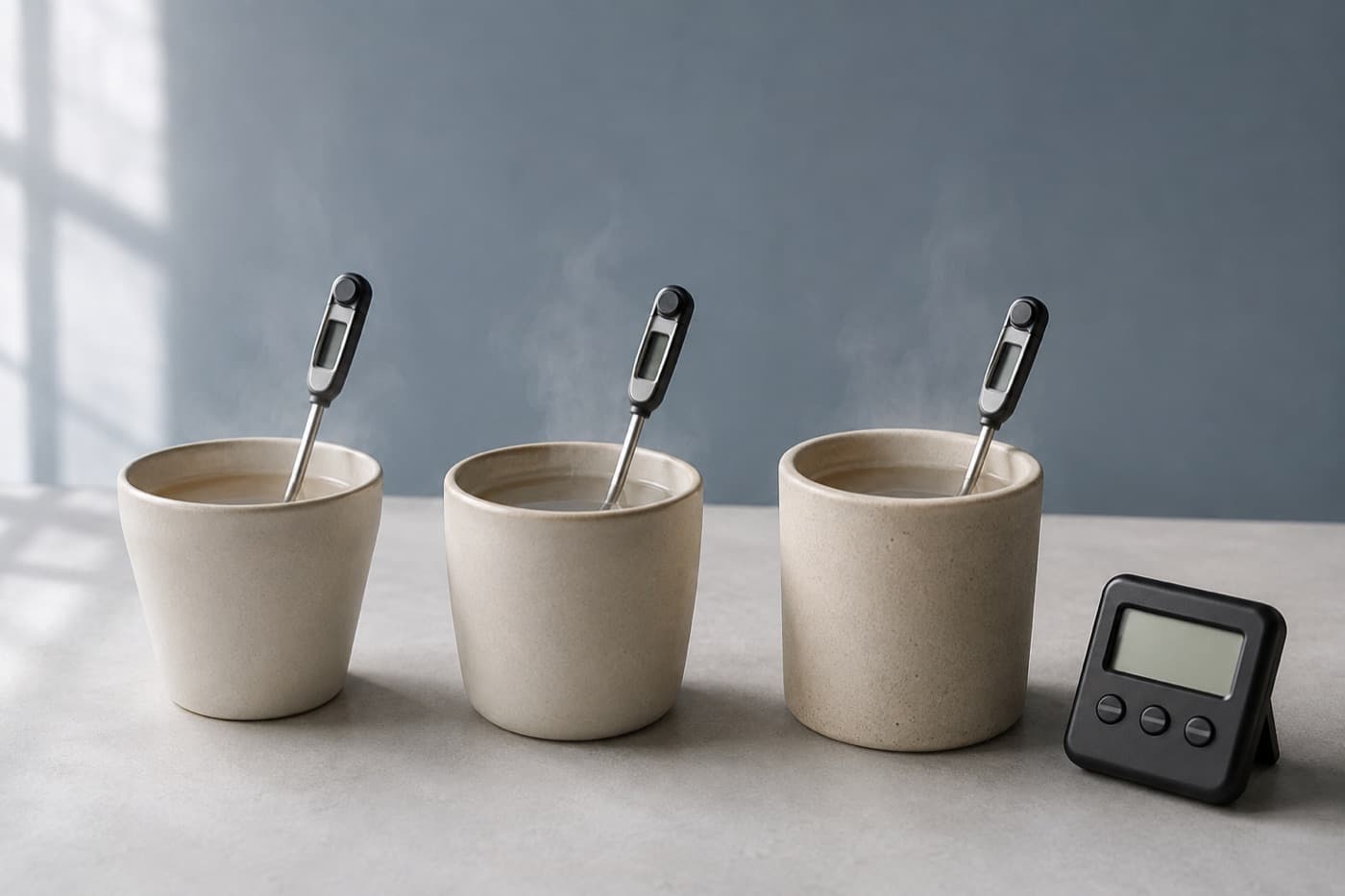
One reading, and a fitted curve
We take one measurement per cup, at ten minutes. The curve you see drawn on a product page is not six measurements — it is Newton’s law of cooling, T(t) = Troom + (Tstart − Troom)·e−kt, with the constant k solved from that single measured endpoint and the known starting temperature.
We say so rather than implying a richer dataset than we have. The shape of the line between 0 and 10 minutes is a model; the point at 10 minutes is a reading. If you only trust one number on the chart, trust the last one.
Wall thickness is the variable
- Tea Cup Thin-Wall 220 ml — 3 mm
- Everyday Mug 300 ml — 6 mm
- Thick-Wall Mug 320 ml — 9 mm
| Minute | Tea Cup Thin-Wall 220 ml — 3 mm | Everyday Mug 300 ml — 6 mm | Thick-Wall Mug 320 ml — 9 mm |
|---|---|---|---|
| 0 | 95 | 95 | 95 |
| 2 | 86 | 88 | 89 |
| 4 | 78 | 82 | 83 |
| 6 | 71 | 76 | 78 |
| 8 | 64 | 71 | 73 |
| 10 | 59 | 66 | 69 |
The reading at ten minutes is measured. The points between are Newton’s law of cooling fitted through it — see how we measure cooling.
Thicker ceramic holds more heat and conducts it away more slowly, so a thick-walled cup reads higher at ten minutes than a thin one. That is the entire mechanism. A cup with a wall of 8 mm or more is the group Cup Match returns when you say your drink goes cold too fast — Cup Match.
Volume confounds the comparison — read this before comparing two cups
A large cup cools more slowly than a small one for a reason that has nothing to do with how it is made: it holds more water, and more water carries more heat relative to the surface it can escape through. A 500 ml mug will beat a 70 ml espresso cup on this test every single time, and that tells you nothing about either cup’s construction.
Compare cups of similar capacity, or the number will mislead you. The comparison worth making is the one above: three cups of broadly comparable size and different wall thicknesses.
The double-walled cup
One cup in the range genuinely has two walls: the Double-Wall Ceramic 250 ml. A 4 mm inner and a 4 mm outer are joined at the rim with an air gap between them. Still air is a poor conductor, so heat leaves the drink more slowly and the outside of the cup stays comfortable to hold. At ten minutes it reads 73 °C, 22 degrees down from 95 °C.
It is still not a vacuum flask, and we do not describe it as one. The gap contains ordinary air at ordinary pressure, not a vacuum, so it conducts and convects heat where a flask’s vacuum does not. And the cup is open at the top, which is where most of the heat leaves any open vessel regardless of what the walls are doing. It cools more slowly than our other cups of that size. That is the claim, and it is the whole claim.
What the test does not cover
- A pre-warmed cup. Rinsing a cup with hot water before filling it makes a real difference and is not in these figures.
- A lid. Everything is tested uncovered so the numbers stay comparable, including the cup that comes with a lid. Using its lid will change the result.
- Milk. Adding cold milk drops the temperature immediately and by far more than any wall thickness recovers.
- Draughts and cold rooms. The bench is still air at 20 °C. A windowsill in winter is not.
- Beyond ten minutes. We do not publish a figure for thirty or sixty minutes because we have not measured one. Every cup here will be at room temperature eventually, and none of them takes long about it.
Every measured figure on the site
All 39 drinking vessels, warmest at ten minutes first. Remember the volume caveat above when reading down this table.
Batch and revision
These readings were taken from the launch production batch. Because wall thickness varies by up to ±5% between hand-finished pieces, an individual cup may read a degree either side of the published figure. We re-measure when a batch changes, and the date at the top of this page tells you when this set was last revised.